Visit Dr. Connie Davis’ Main Website
www.corneliaedavismd.com

The Global Ebook Awards are more than an honor for the best ebooks published, they offer high-profile publicity for ebook authors, publishers and the ebook entered. Recognizing authors so that more readers will discover your ebook
Kirkus Review
By Kirkus Review
An American doctor tells of her experience fighting smallpox in India. In this debut memoir, Davis recounts the years she spent as a young doctor working with the World Health Organization in the 1970s. The book blends elements of travelogue, as Davis was determined to experience the country of India during her stay, with descriptions of administering a smallpox vaccine program, tracking the spread of disease in rural communities, and navigating post-colonial and intergovernmental bureaucracies. The author was the only African-American woman in a group composed largely of white American and European men, which offered her a unique perspective on the communities she worked with. However, as a Western woman, she faced some challenges in the field that her male colleagues didn’t (“Experienced field epidemiologists told me that I would ruin my kidneys and that I needed to drink more water. They were all men. Where was I to pee?”). She was exempt from many of the traditional local restrictions placed on women, though, and at times her complexion allowed her to pass as Indian and access dangerous areas that the WHO had forbidden its staff to enter. As a Catholic, she found lodging and friendship among the rural missionaries, and she writes movingly of a visit to Mother Teresa’s hospice. She draws a vivid picture of India and the regions she worked in, from West Bengal (“the kaacha roads, the heavily overloaded bullock carts headed for market, the bicycle rickshaws vigorously moving in and out of the congested traffic, and the ubiquitous sacred cow just wandering down the middle of the road”) to Rajasthan (“I met children living in the desert who were ten years old and had never seen rain”). Her descriptions of small details of daily life will allow readers to easily picture the world that she encountered 40 years ago. An engaging, readable depiction of the foreign-aid worker experience.
By IndieReader
“A compelling, though imperfectly-told, true story of one brave woman’s role in eradicating smallpox in India. DISRUPTER is the true story of a remarkable woman making medical history, and for that reason it’s worth reading.”
What if the biggest risk of your life is the one you never took?
Dr. Cornelia Davis spent thirty five years working across twenty countries in Africa and Asia, chasing infectious disease outbreaks, trekking to the base camp of Mount Everest, crossing borders most travelers would avoid, and building a career few people, let alone a woman who grew up as the only Black girl in her neighborhood and later one of the only Black women in her medical school class, were ever expected to have. None of it happened because it was safe. It happened because she chose the chance over the comfort of staying put. In Risking Is Better Than Regretting, Davis shares the stories behind those choices and distills them into three simple ideas she calls the Three Cs: Choice, Chance, and Change. Through personal stories from Kathmandu to Nairobi to Kabul, she shows readers how to build their own do-over list, focus on what actually adds meaning to a life, and stop mistaking caution for safety. This is not a book about reckless risk. It is a book about the regret that comes from never asking the question at all. Wherever you are in your own journey, it is not too late to choose the chance.
REVIEWS
Tanja Slijepcevic – The International Review of Books
The author, Cornelia E. Davis, is a remarkable human being, a global practicing physician, and worldwide traveler. In her compelling memoir/self-help book, she shares her amazing experiences on how to live well while taking intelligent risks. As a result, we see how her willingness to do this on a global scale has enriched her life, brought many friends from around the world, and helped others through her medical practice in remote places where the need is greatest.
Dr. Davis is a wonderful tour guide and I learned not only from her life lessons but by her incredible travel experiences. She has made me want to get out there and risk more, see the world, and grow deeply as a result. I reveled in her adventures and cheered her on as she explored wonderful and sometimes dangerous places, using information from others and her intuition as a guide.
I was especially struck by her courage, not only to face being the only black African-American girl in an all-white California neighborhood, but also the only black female student at med school. She was blessed to have an incredible family who supported her dreams and career choices. And she describes gaining confidence while traveling and living outside the U.S. Her amazing spirit allowed her to carry on despite obstacles and embrace life…I loved this memoir/self-help manual and learning about oneself through intelligent risk-taking while traveling. To see the world through the eyes of the remarkable author was a privilege and pleasure!

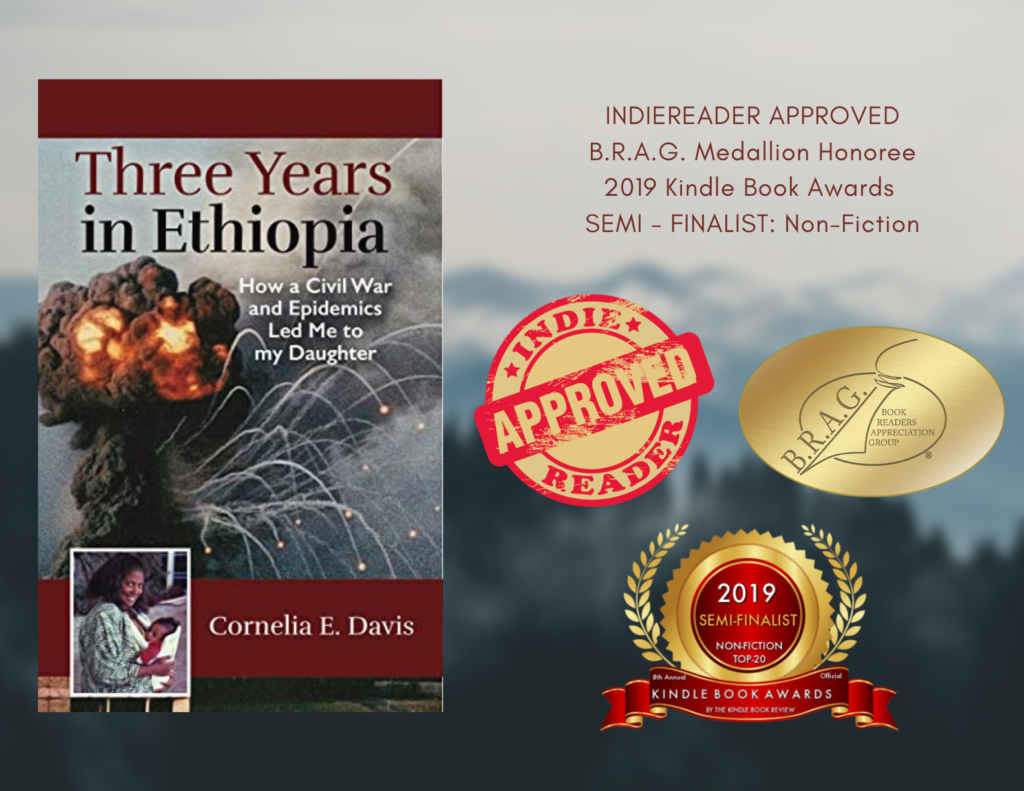
Sent by the World Health Organization to assist the Ethiopian government in preventing meningitis outbreaks in 1990, Dr. Cornelia Davis eagerly accepted this posting. She headed to Addis Ababa, unaware of an obscure war that had gone on for two decades. The doctor had an ulterior motive — she wanted to adopt an infant girl. While providing expert assistance to control epidemics in several countries, Connie submitted her adoption application. Rebels captured previous strongholds of the Ethiopian government and the Prime Minister fled. Connie was left in charge of the WHO EPR Unit. The airport closed and the rebels entered the capital. In the midst of this chaos, Davis was approved to look for an orphan. You’ll be on the edge of your seat as you read about the explosive series of events which destroyed Connie’s house and led her to an infant girl found on the steps of St. George Cathedral. One look, and Connie knew she had found her daughter. Five days later, she was ordered by WHO to evacuate to Geneva. But not without her daughter!
REVIEWS